# From text to tokens to next-token probabilities {#sec-tokens}
**You will learn:**
- how a language model turns text into integers called *tokens*, and what that does to ConvFinQA's numbers;
- how to read a tokenization, using a colour-coded view of real questions, table rows and programs.
A language model never sees letters or digits. It sees a sequence of integers. The **[tokenizer](901_glossary.qmd#gloss-token)** splits
text into pieces from a fixed vocabulary and replaces each piece by its position in that vocabulary.
This chapter works with the model we fine-tune later, `Qwen/Qwen3-4B-Instruct-2507`.
## From text to tokens
```{python}
from transformers import AutoTokenizer

from convfinqa import data
from convfinqa.book.viz import show_tokens, tokenize

tok = AutoTokenizer.from_pretrained("Qwen/Qwen3-4B-Instruct-2507")
print(f"vocabulary size: {len(tok):,}")
```
The helper `show_tokens` colours each token. Hover over a token to see its id. Examples come from the
`train` split.
### A question
```{python}
conv = {c["id"]: c for c in data.load_split("train")}[
    "Single_AAPL/2002/page_23.pdf-1"
]
question = conv["annotation"]["dialogue_break"][0]
show_tokens(tok, question)
```
Common words are single tokens, and the space in front of a word belongs to the word: `␣was`, `␣the`.
The year `2001` is not one token. It is four.
### A table row
```{python}
row = data.table_to_markdown(conv["table"]).splitlines()[2]
show_tokens(tok, row)
```
The symbols and separators `|`, `$` and the spaces around them cost tokens too. A table of a few dozen
cells is already hundreds of tokens, which is why a whole report page makes a long prompt.
### Numbers
```{python}
for text in ["206588", "0.14136", "1,234.5", "28%", "$ 5742"]:
    display(show_tokens(tok, text))
```
Every digit is its own token. The same digits give the same tokens wherever they appear:
```{python}
display(show_tokens(
    tok,
    "net cash from operating activities was 181001 in 2008, so 181001 is the base"
))
```
The model never sees `181001` as one unit, only the digit sequence `1 8 1 0 0 1`. This follows from
the tokenizer's design (see below), and it is one reason why we do not ask the model to do arithmetic
itself. It writes a program, and the executor from @sec-dsl computes the number.
### A gold program
```{python}
show_tokens(tok, conv["annotation"]["turn_program"][-1])
```
The DSL was not designed for this tokenizer. Some pieces merge in surprising ways, such as `),` and
`(#`, and an operator takes its leading space with it (`␣divide`). Fine-tuning teaches the model to
produce exactly this token sequence.
### Another tokenizer, for contrast
GPT-2's tokenizer has no rule that isolates digits. Its vocabulary merges digits that were frequent
together in its training text, so the same number can be cut differently in different places.
```{python}
gpt2 = AutoTokenizer.from_pretrained("gpt2")
for text in ["206588", " 181001", "0.14136"]:
    print(f"GPT-2: {text!r}")
    display(show_tokens(gpt2, text))
    print(f"Qwen3: {text!r}")
    display(show_tokens(tok, text))
```
For arithmetic this is awkward either way, but Qwen's digit-by-digit split is at least consistent: a
digit is always one token, whatever its neighbours are.
::: {.callout-note title="Under the hood"}
Qwen's tokenizer is a **[byte-level BPE](901_glossary.qmd#gloss-bpe)** tokenizer. Its vocabulary was built by starting from single
bytes and repeatedly merging the most frequent adjacent pairs in a large text corpus. Before any
merging applies, a **pre-tokenizer** first splits the text with a regular expression. Part of Qwen's
expression is `\p{N}`, which matches a single digit, so a digit can never merge with its neighbours.
```{python}
import json

pre = json.loads(tok.backend_tokenizer.to_str())\
    ["pre_tokenizer"]["pretokenizers"][0]["pattern"]["Regex"]
print(pre)
```
:::
## Tracing one prediction
Now we follow a single prediction through the model. The model's only job is to read a sequence of
tokens and say how likely each possible **next** token is. We take the first turn of the conversation
from above, formatted as a chat, and stop right where the assistant's answer begins.
```{python}
import torch
from transformers import AutoModelForCausalLM

from convfinqa.formatting import conversation_messages

# the system prompt and the first user turn
messages = conversation_messages(conv)[:2]

prompt = tok.apply_chat_template(
    messages, tokenize=False, add_generation_prompt=True
)

print("...", repr(prompt[-70:]))
gold = conv["annotation"]["turn_program"][0]
print("gold answer:", gold)
```
The prompt ends with `<|im_start|>assistant` and a newline: the model is about to write its answer. The
gold answer is `5363`, so the right first token is `5`. We load the model in bf16 on the GPU (the first
run downloads about 8 GB).
```{python}
name = "Qwen/Qwen3-4B-Instruct-2507"
model = AutoModelForCausalLM.from_pretrained(name, dtype=torch.bfloat16)\
    .to("cuda").eval()
cfg = model.config
print(f"{cfg.num_hidden_layers} layers, hidden size {cfg.hidden_size}, vocabulary rows {cfg.vocab_size:,}")
```
### Token ids
```{python}
ids = tok(prompt, add_special_tokens=False, return_tensors="pt")\
    ["input_ids"].to("cuda")
print("shape:", tuple(ids.shape), "(batch, tokens)")
print(
    "last five ids:",
    ids[0, -5:].tolist(),
    [tok.decode([i]) for i in ids[0, -5:]]
)
```
### Embeddings
Each id selects one row of a big table, the **embedding matrix**, which has one row per vocabulary entry.
The row is a vector of `{python} f"{model.config.hidden_size:,}"` numbers that the model learned for that token.
```{python}
with torch.no_grad():
    emb = model.model.embed_tokens(ids)
print("embedding matrix:", tuple(model.model.embed_tokens.weight.shape))
print("after lookup:", tuple(emb.shape), emb.dtype, "(batch, tokens, hidden)")
```
### The transformer
The vectors pass through 36 transformer layers. Each layer adds an update to every position's vector, so the vector is a running sum that every layer nudges, and its shape never changes. What happens inside a layer, attention across positions and a small network at each position, is the subject of the next chapter. For now the stack is a black box that maps vectors to vectors. We feed the embeddings from the previous step straight in. `output_hidden_states` keeps the vectors at
every stage: entry 0 is the embeddings we put in, entry *k* is what layer *k* produced, and the last
entry is the transformer's final output, which is what the next step uses.
```{python}
with torch.no_grad():
    out = model.model(inputs_embeds=emb, output_hidden_states=True)
hidden = out.last_hidden_state
print("hidden states kept:", len(out.hidden_states), "= embeddings + 36 layers")
print("final hidden state:", tuple(hidden.shape))

# the last entry is the final output, and feeding ids instead
# gives the same result: the model simply does the embedding lookup itself
assert torch.equal(out.hidden_states[-1], hidden)
with torch.no_grad():
    assert torch.equal(hidden, model.model(input_ids=ids).last_hidden_state)
```
The meaning of a position's vector changes on the way through. It starts as the embedding of token *i*.
By the end it encodes a prediction for the token at position *i* + 1.
### Logits
The last step turns each position's vector into one score per vocabulary entry. These scores are the
**[logits](901_glossary.qmd#gloss-logits)**. A matrix with `{python} f"{model.config.vocab_size:,}"` rows, one per vocabulary entry, the language-model head, does the multiplication.
```{python}
with torch.no_grad():
    logits = model.lm_head(hidden)
print("logits:", tuple(logits.shape), "(batch, tokens, vocabulary rows)")
```
In this model the head's weights are the embedding matrix itself (more on that at the end). So the
score of a token is the dot product of the final vector with that token's embedding: the final vector
scores highest on the tokens it points toward.
```{python}
E = model.model.embed_tokens.weight                 # one embedding per vocabulary row
manual = hidden[0, -1].float() @ E.float().T        # dot product with every token's embedding
head = logits[0, -1].float()
diff = (manual - head).abs().max().item()
print(f"logits range from {head.min().item():.1f} to {head.max().item():.1f}")
print(f"largest difference between the two: {diff:.3f}")
assert diff < 0.07 and manual.argmax() == head.argmax()
```
The two agree up to rounding. The head stores its logits in bf16, whose spacing near 20 is 0.125, so
a difference of up to half that, about 0.06, is just the rounding, and the top token is the same.
Every position gets its own row of logits: position *i* scores the token that should come at *i* + 1.
For writing an answer only the **last** position matters, because the prompt is already given.
(Training uses all of them; see the chapter on how fine-tuning works.) We check that our step-by-step path reproduces the
model's own forward pass exactly:
```{python}
with torch.no_grad():
    assert torch.equal(logits, model(input_ids=ids).logits)
last = logits[0, -1].float()
print("scores for the next token:", tuple(last.shape))
```
### Softmax and the prediction
Logits are arbitrary real numbers. **[Softmax](901_glossary.qmd#gloss-softmax)** turns them into probabilities: it exponentiates each
score and divides by the total, so every value is positive and they sum to 1.
```{python}
probs = torch.softmax(last, dim=-1)
best = int(probs.argmax())
gold_id = tok(gold, add_special_tokens=False)["input_ids"][0]
rank = int((probs > probs[gold_id]).sum()) + 1

print(f"probabilities sum to {probs.sum().item():.4f}")
print(f"most likely next token: {tok.decode([best])!r} with probability {probs[best]:.3f}")
print(f"the gold first token {tok.decode([gold_id])!r}: probability {probs[gold_id]:.3f}, rank {rank}")
```
The untuned model does not know our DSL. It starts a Markdown code block and gives the correct first
digit a few percent. Nothing in the pipeline was wrong; the model simply has not seen this task. Teaching
it is what fine-tuning does, and we will measure this exact quantity on whole conversations in @sec-probing.
### The whole path
```{python}
import pandas as pd

pd.DataFrame(
    [
        (
            "token ids",
            tuple(ids.shape),
            "integers from the tokenizer"
        ),
        (
            "embeddings",
            tuple(emb.shape),
            "one learned vector per token"
        ),
        (
            "after 36 layers",
            tuple(hidden.shape),
            "vectors that have read the whole prompt"
        ),
        (
            "logits",
            tuple(logits.shape),
            "one score per vocabulary row, at every position"
        ),
        (
            "last position",
            tuple(last.shape),
            "scores for the next token"
        ),
        (
            "softmax",
            tuple(probs.shape),
            "probabilities, summing to 1"
        ),
    ],
    columns=["stage", "shape", "meaning"],
)
```
::: {.callout-note title="Under the hood"}
The vocabulary has `{python} f"{len(tok):,}"` tokens but the matrices have `{python} f"{model.config.vocab_size:,}"` rows. The extra rows are padding that
makes the sizes friendlier to the GPU. They correspond to no token:
```{python}
n_tokens = len(tok)
print(f"probability on the {cfg.vocab_size - n_tokens} padding rows: {probs[n_tokens:].sum().item():.2e}")
```
The embedding matrix and the language-model head are also **the same tensor** in this model (the
config says `tie_word_embeddings`), so the table that turns a token into a vector is reused to turn a
vector back into token scores:
```{python}
print(
    "tied:",
    cfg.tie_word_embeddings,
    "| same memory:",
    model.lm_head.weight.data_ptr() == model.model.embed_tokens.weight.data_ptr()
)
```
:::
## The distribution over next tokens
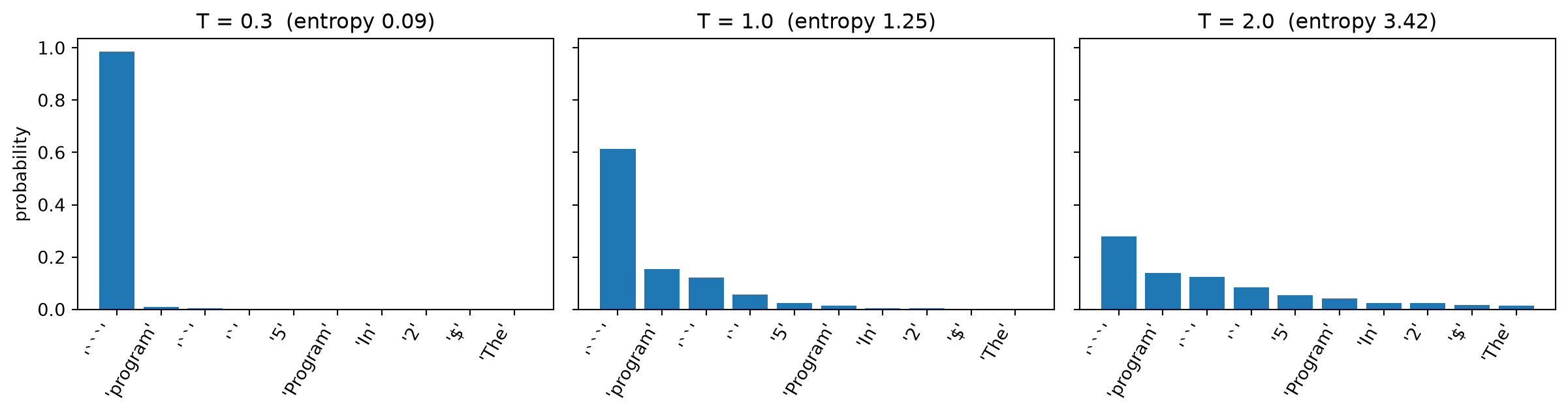
The softmax output is a whole **probability distribution** over the vocabulary, not just a winner. Here
are the ten most likely next tokens for the prompt above, and how they change with the **temperature**
*T*: before the softmax, the logits are divided by *T*.
```{python}
#| fig-cap: "The ten most likely next tokens at three temperatures."
from convfinqa.book.viz import next_token_stats, plot_next_token

plot_next_token(tok, last, temperatures=(0.3, 1.0, 2.0), k=10);
```
- At *T* = 1 the logits are used as they are. This is the model's own distribution.
- A low *T* sharpens it: the leader takes almost everything. As *T* approaches 0, the result is just the
argmax.
- A high *T* flattens it: the tail of unlikely tokens gains probability.
The **[entropy](901_glossary.qmd#gloss-entropy)** in the panel titles summarises the spread: it is 0 when one token has all the probability,
and grows as the distribution flattens. The same numbers as a table:
```{python}
pd.DataFrame(
    {f"T = {t}": next_token_stats(last, t, 10) for t in (0.3, 1.0, 2.0)}
).T.round(3)
```
```{python}
stats = {t: next_token_stats(last, t, 10) for t in (0.3, 1.0, 2.0)}
gold_id = tok(gold, add_special_tokens=False).input_ids[0]
p_gold = {t: torch.softmax(last.float() / t, dim=-1)[gold_id].item() for t in (1.0, 2.0)}

# the paragraph below
assert stats[0.3]["top1"] > 0.9
assert stats[2.0]["top10_mass"] < 0.9
assert p_gold[2.0] > 2 * p_gold[1.0]
```
At *T* = 0.3 the top token holds `{python} f"{stats[0.3]['top1']:.0%}"` of the probability. At *T* = 2 the ten tokens shown hold only
`{python} f"{stats[2.0]['top10_mass']:.0%}"` of it, and the gold token `{python} tok.decode([gold_id])` has more than doubled its probability, from `{python} f"{p_gold[1.0]:.3f}"` to `{python} f"{p_gold[2.0]:.3f}"`. The
model is not any better informed; the distribution is just less sure of itself.
## Choosing a token: greedy and sampling
To write more than one token, the model repeats the trace: it picks a token, appends it to the input,
and predicts again. How it picks decides everything about the output.
- **[Greedy decoding](901_glossary.qmd#gloss-greedy)** always takes the most likely token. Nothing is random, so the same input gives the
same output.
- **[Sampling](901_glossary.qmd#gloss-sampling)** draws the next token at random from the (temperature-adjusted) distribution, so the
output varies from run to run. A random-number **seed** makes a sampled run repeatable.
Before we try both, one pitfall. The model ships with default generation settings:
```{python}
gc = model.generation_config
print({k: getattr(gc, k) for k in ("do_sample", "temperature", "top_p", "top_k")})
```
These are sampling settings, so `model.generate()` with no arguments **samples**. Whenever we want greedy
decoding we pass `do_sample=False` explicitly, and for sampling we pass every setting explicitly too.
```{python}
def continuation(max_new_tokens=14, **kwargs):
    with torch.no_grad():
        out = model.generate(ids, max_new_tokens=max_new_tokens, **kwargs)
    return tok.decode(out[0, ids.shape[1]:])

greedy = dict(do_sample=False, temperature=None, top_p=None, top_k=None)
sampled = dict(do_sample=True, temperature=1.0, top_p=1.0, top_k=0)

rows = [
    ("greedy", "-", continuation(**greedy)),
    ("greedy again", "-", continuation(**greedy))
]
for seed in (0, 1, 2, 0):
    torch.manual_seed(seed)
    rows.append(("sampled", seed, continuation(**sampled)))
assert rows[0][2] == rows[1][2]   # greedy is repeatable
assert rows[2][2] == rows[5][2]   # so is sampling with the same seed

# pandas cuts longer cells at 50 characters
pd.set_option("display.max_colwidth", 80)

pd.DataFrame(rows, columns=["decoding", "seed", "first 14 tokens"])
```
Greedy gives the same text twice. Sampling gives different text for different seeds, and the same text
again for the same seed. The untuned model's greedy answer is not our DSL, but it does contain the right
number. It is also the reason this matters later: **greedy evaluation is deterministic, so the evaluation
chapter has no generation seed to report**. Only the training seed varies between runs.
```{python}
# the same prompt alone and padded inside a batch with a longer one
tok.padding_side = "left"
batch = tok(
    [prompt, prompt + "\nAnswer:"], add_special_tokens=False,
    padding=True, return_tensors="pt"
).to("cuda")
positions = (batch.attention_mask.cumsum(-1) - 1).clamp(min=0)
with torch.no_grad():
    alone = model(ids).logits[0, -1].float()
    together = model(**batch, position_ids=positions).logits[0, -1].float()
batch_diff = (alone - together).abs().max().item()
same_top = alone.argmax() == together.argmax()
print(f"largest change in the logits: {batch_diff:.2f} "
      f"(logits range from {alone.min().item():.0f} to {alone.max().item():.0f}); "
      f"same top token: {bool(same_top)}")
assert batch_diff > 0 and same_top
```
::: {.callout-note title="Deterministic, but only for the same setup"}
Greedy decoding is deterministic given the same input, model weights, software and hardware. Running
the same prompt inside a different batch can change the logits in bf16, as the check above shows: by up to
`{python} f"{batch_diff:.2f}"` on logits ranging from `{python} f"{alone.min().item():.0f}"` to `{python} f"{alone.max().item():.0f}"`, with the same top token. That can
flip a near-tie. We evaluate with a fixed batch size and a fixed order of examples for this
reason.
:::
## Editing the logits
A **[logits processor](901_glossary.qmd#gloss-logits-processor)** is a function that edits the logits after the model produces them and before
the softmax. The simplest edit is a **mask**: adding $-\infty$ to a token's logit makes its probability
exactly 0, and the probabilities of the remaining tokens renormalise to sum to 1.
Say we know the answer to this question is a number, and we allow only the ten digit tokens:
```{python}
from convfinqa.constrained import AllowedTokens

digit_ids = [
    tok(str(d), add_special_tokens=False)["input_ids"] for d in range(10)
]
assert all(len(x) == 1 for x in digit_ids)
digit_ids = [x[0] for x in digit_ids]

processor = AllowedTokens(digit_ids)
masked = processor(ids, last[None])[0]
p_masked = torch.softmax(masked, dim=-1)
top = p_masked.topk(3)

print(
    f"P('5') before the mask: {probs[gold_id]:.3f}, after: {p_masked[gold_id]:.3f}"
)
print(
    "top three now:",
    [
        (tok.decode([int(i)]), round(v, 3))
        for v, i in zip(top.values.tolist(), top.indices)
    ]
)
```
The code fence and `program` are gone, and the model's own ranking of the digits decides the rest. Using
the processor inside `generate`:
```{python}
from transformers import LogitsProcessorList

print(repr(continuation(
    max_new_tokens=4,
    logits_processor=LogitsProcessorList([processor]),
    **greedy
)))
```
The model writes `5363`, the gold answer. The mask taught the model nothing: it only removed the
options it would have preferred, and the digits it already ranked highest did the rest. That works
here because the right answer was already the model's favourite digit sequence, and it is not
guaranteed in general. This mask is also far too crude. It can never end the answer, because the
end-of-turn token is not allowed, and it cannot write an operator or a parenthesis. A useful
constraint changes the allowed set at every step depending on what has been written so far. That is a
**[grammar](901_glossary.qmd#gloss-grammar)**, the subject of the [constrained-decoding](901_glossary.qmd#gloss-constrained-decoding) chapter.