# What ConvFinQA looks like {#sec-convfinqa}
**You will learn:**
- how a ConvFinQA conversation is built from one page of an earnings report;
- what the questions, programs and answers look like, for both conversation types;
- how big the data is, and how long a full conversation gets in tokens, which sets `max_length` for training.
ConvFinQA [@chen2022convfinqa] turns FinQA questions about earnings-report pages into multi-turn
conversations. Each page has text before a table, the table, and text after it. A conversation asks a
chain of questions about that page, and each turn has a small **program** in a domain-specific
language ([DSL](901_glossary.qmd#gloss-dsl)) that computes the answer.
## Getting the data
The code lives in `src/convfinqa/data/`. The download clones the authors' repository and unzips
`data.zip` into `data/raw/`, and does nothing if the data is already there.
```{python}
import json
from collections import Counter
from pathlib import Path

import matplotlib.pyplot as plt
import pandas as pd

from convfinqa import data
from convfinqa.dsl import steps

data.download_data()

splits = {
    name: data.load_split(name)
    for name in ["train", "dev", "test", "train_turn", "dev_turn"]
}

pd.DataFrame({
    "rows": {k: len(v) for k, v in splits.items()},
    "has labels": {
        k: "annotation" in v[0] and "turn_program" in v[0]["annotation"]
        for k, v in splits.items()
    }
})
```
The official test split has questions but no answers, so **we use `dev` as our test set**. For tuning we
carve a validation split out of `train` in a later chapter.
The `*_turn` files hold the same conversations unrolled to one row per turn. We work from the
conversation files and unroll ourselves, which the counts above confirm gives the same number of turns:
```{python}
n_turns = {
    s: sum(len(c["annotation"]["dialogue_break"])
    for c in splits[s]) for s in ["train", "dev"]
}

assert n_turns["train"] == len(splits["train_turn"])\
    and n_turns["dev"] == len(splits["dev_turn"])

n_turns
```
## One record
A conversation is a JSON object. The fields we use are `pre_text`, `table`, `post_text`, and under
`annotation`: `dialogue_break` (the questions), `turn_program`, `exe_ans_list` (the answers) and
`qa_split` (see Type II below).
```{python}
by_id = {c["id"]: c for c in splits["train"]}
conv_I = by_id["Single_AAPL/2002/page_23.pdf-1"]

print("Top-level keys of the conversation:")
print(sorted(conv_I.keys()))

print("Annotation keys of the conversation:")
print(sorted(conv_I["annotation"].keys()))
```
## A Type I conversation
[Type I conversations](901_glossary.qmd#gloss-conversation-types) decompose **one** FinQA question into a chain of turns. First the page the model
sees: the text before the table (shortened here), the table as markdown, and the text after.
```{python}
from IPython.display import Markdown

def show_page(conv, n=300):
    pre = " ".join(conv["pre_text"])
    post = " ".join(conv["post_text"])
    return Markdown(
        f"*pre_text ({len(conv['pre_text'])} sentences):* …{pre[-n:]}\n\n"
        + data.table_to_markdown(conv["table"])
        + f"\n\n*post_text ({len(conv['post_text'])} sentences):* {post[:n]}…"
    )

show_page(conv_I)
```
Then the conversation, one turn per line: question, gold program, and the number the program computes.
```{python}
print(data.format_conversation(conv_I))
```
The first turns just **select a number** from the table. Later turns compute with them. The last turn
restates the full calculation, using `#0` for "the result of step 0" so the program stays self-contained.
## A Type I conversation with a garbled table
Not every page is this clean. Here is another Type I conversation, whose table header is garbled in
the dataset.
```{python}
conv_garbled = by_id["Single_JKHY/2009/page_28.pdf-3"]
show_page(conv_garbled)
```
::: {.callout-warning title="The header of this table is garbled in the dataset"}
The raw `table_ori` shows what went wrong. The header was split across two rows:
```{python}
for row in conv_garbled["table_ori"][:3]:
    print(row)
```
Read together, the first two rows are a single header row, `['', 'Year ended June 30, 2009', '2008',
'2007']`, whose first label was extracted on a separate line from the other two. The cleaned `table`
then built a header from the broken pieces: its columns repeat fragments of "year ended june 30 2009",
and the year labels also show up in `pre_text` (the trailing `: 2009 2008 2007 .`). This is how the
data ships, not a parsing error of ours.
The model must work out that the columns are 2009, 2008 and 2007 from the table and the
surrounding text, which is part of the task.
:::
```{python}
print(data.format_conversation(conv_garbled))
```
Most tables are clean. The check below counts how many have repeated header cells:
```{python}
dup_header = sum(
    len(set(c["table"][0])) < len(c["table"][0])
    for c in splits["train"]
)
print(
    f"{dup_header} of {len(splits['train'])} train tables repeat a header "
    f"cell ({dup_header / len(splits['train']):.1%})"
)
```
## A Type II conversation
Type II conversations merge **two** FinQA questions about the same page. `qa_split` marks which turns
belong to which: 0s, then 1s.
```{python}
conv_II = next(
    c for c in splits["train"]
    if data.conversation_type(c) == "II"
    and len(c["annotation"]["dialogue_break"]) == 6
)
print(data.format_conversation(conv_II))
print("qa_split:", conv_II["annotation"]["qa_split"])
```
## The DSL
A program is a comma-separated list of steps, `op(arg, arg)`. A turn that only selects a number has
a bare number as its program. The operations are `add`, `subtract`, `multiply`, `divide`, `exp` and
`greater`. (The authors' code also lists FinQA's `table_sum`, `table_average`, `table_max` and
`table_min`, but no ConvFinQA gold program uses them.) An argument is one of:
- a **number literal** copied from the page, such as `206588` or `0.14136`, possibly with a `%`
sign, such as `19%`;
- a **step reference** `#k`, the result of step *k*;
- a **constant** from a fixed list.
The chapter on the DSL and its executor covers the grammar and the executor in detail. Here we look
at what makes an argument a literal or a constant, and how the paper's model decides what it may write.
### Constants
The constants are not read from the page. The authors' code defines a fixed list of constants, and every
constant in the train and dev programs is in it:
```{python}
import re

const_use = Counter(
    c
    for s in ["train", "dev"]
    for conv in splits[s]
    for p in conv["annotation"]["turn_program"]
    for c in re.findall(r"const_\w+", p)
)
assert set(const_use) <= set(steps.CONSTANTS)

pd.Series(
    {c: const_use.get(c, 0) for c in steps.CONSTANTS},
    name="uses (train + dev)"
).to_frame().T
```
The list has `{python} len(steps.CONSTANTS)` constants.
They are mostly scale factors and counts: `const_100` turns a ratio into a percentage,
`const_1000` and `const_1000000` convert units, and small integers such as `const_3` count years for an
average (the Type II example above ends with `divide(#1, const_3)`). The rule is by convention, not
by whether the digits occur on the page: a number the question needs but does not read from the
document is a constant, and the same digits read off the page are a literal.
### Percentages and the executor
The official executor (`str_to_num` in the authors' `general_utils.py`) strips commas and tries to
read a float. If that fails and the string contains `%`, it removes the sign and divides by 100, so
`19%` is evaluated as 0.19. A `const_` token is replaced by its number (`const_m1` is -1). The
executor never looks at the page: whether a program may use `19%` at all is decided elsewhere.
### What the paper's decoder may write
FinQANet's generator [@chen2022convfinqa] is restricted: at each step it can emit an operator, a
constant from the list, a step reference, or a number **copied from its input**. Its input is the
question plus the context it is given (supporting text and table rows), split on spaces, and a token counts as a copyable number if, after
removing commas, it parses as a number *or ends with `%`*. This is the rule, implemented in
`steps.copyable_numbers`:
```{python}
row = " ".join(conv_I["table"][-1])
print(row)
print(steps.copyable_numbers(row))
```
This works because the page text is pre-tokenized: punctuation and symbols are separated from the
surrounding text by spaces (`$ 103102`, `june 30 , 2009`, `( 2913 )`), so numbers can be extracted
cleanly. The exception is `%`, which the data keeps attached to its number in the first form
(`28%`) and also writes as a separate token in the parenthesised form (`( 28 % )`). The attached
`28%` is a candidate. In the spaced form, `28` is a candidate and the lone `%` also passes the rule,
which looks like an accidental quirk of the check.
Whether our own models should be restricted this way is a separate question, taken up in the
constrained-decoding chapter.
## How big is it?
```{python}
rows = []
for split in ["train", "dev"]:
    for c in splits[split]:
        for t in data.turns(c):
            rows.append({
                "split": split,
                "id": c["id"],
                "type": data.conversation_type(c),
                "turn": t.index + 1,
                "number_turn": steps.is_number_turn(t.program),
                "program": t.program
            })
df = pd.DataFrame(rows)

per_conv = df.groupby(["split", "id", "type"]).size()\
    .rename("turns").reset_index()

summary = per_conv.groupby("split").agg(
    conversations=("id", "count"),
    turns=("turns", "sum"),
    mean_turns=("turns", "mean")
)

summary["type II share"] = per_conv.assign(ii=per_conv.type == "II")\
    .groupby("split").ii.mean()

summary.round(2)
```
```{python}
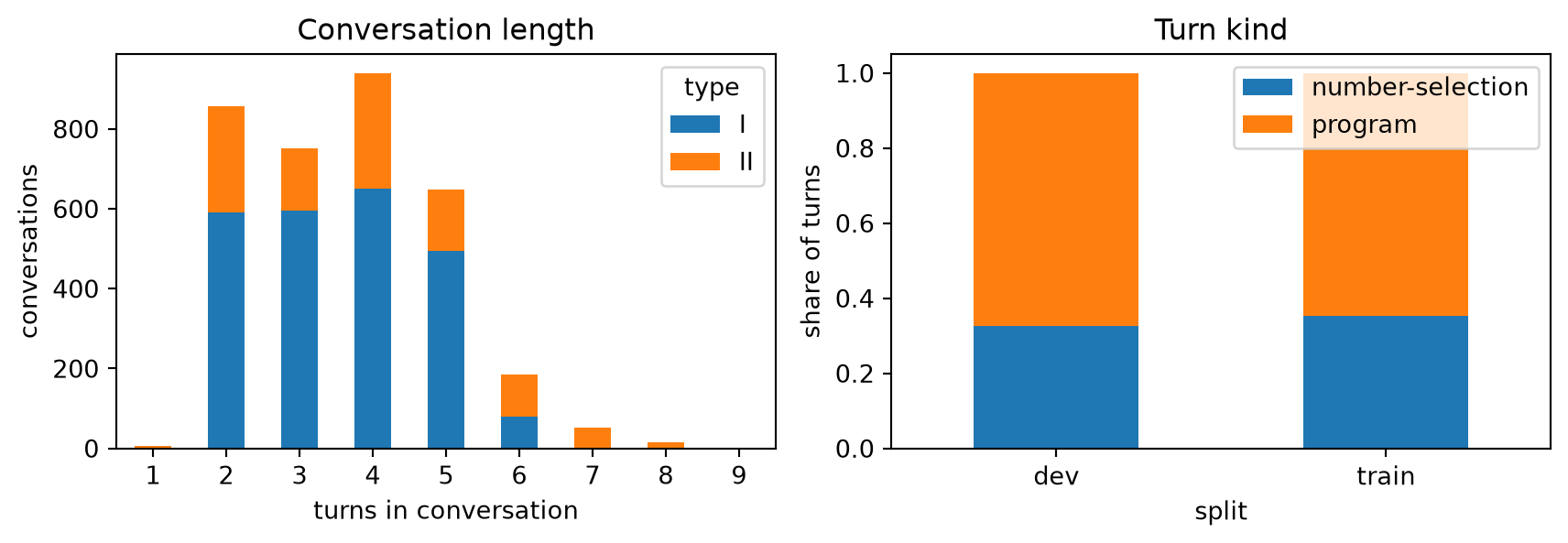
#| fig-cap: "Turns per conversation (train + dev) and the share of number-selection vs. program turns."
fig, ax = plt.subplots(1, 2, figsize=(9, 3.2))
pivot = per_conv.groupby(["turns", "type"]).size().unstack(fill_value=0)
pivot.plot.bar(stacked=True, ax=ax[0], rot=0)

ax[0].set(
    xlabel="turns in conversation",
    ylabel="conversations",
    title="Conversation length"
)

share = df.groupby("split").number_turn.mean()

share.rename("number-selection").to_frame().assign(program=1 - share)\
    .plot.bar(stacked=True, ax=ax[1], rot=0)

ax[1].set(ylabel="share of turns", title="Turn kind")
plt.tight_layout()
```
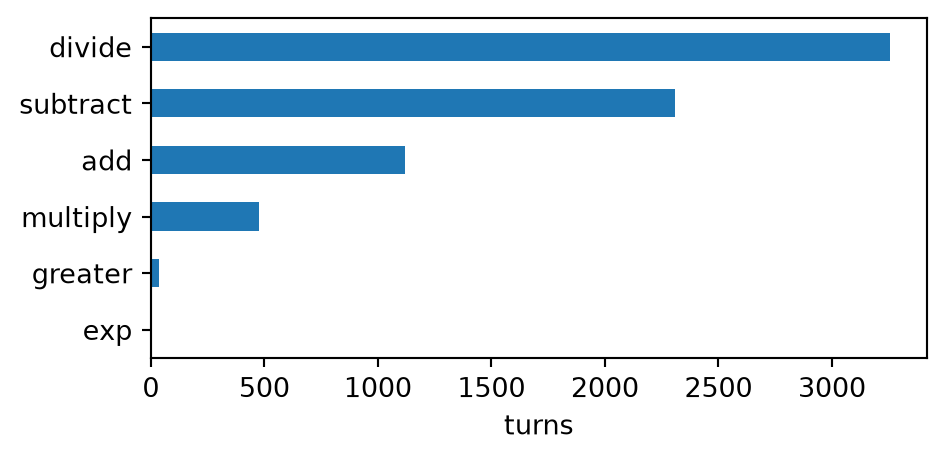
The DSL operations are counted from the **new step each turn adds**: the last step of its program,
since each program repeats the earlier steps.
```{python}
#| fig-cap: "How often each DSL operation is the new step of a turn (train)."
ops = Counter()
for p in df[(df.split == "train") & ~df.number_turn].program:
    ops[steps.split_steps(p)[-1].split("(")[0]] += 1
pd.Series(ops).sort_values().plot.barh(figsize=(5, 2.5), xlabel="turns")
plt.tight_layout()
ops
```
## How long is a conversation in tokens?
Training uses one sequence per **full conversation**: the system prompt, the page, and every question and
answer. So the longest conversations set the memory we need. Turning a data row into token ids takes
three steps:
1. **Row to messages.** Our own choice, in `conversation_messages` (`src/convfinqa/formatting.py`): a
system prompt, then the page and the first question as the first user message, then the gold
program as the assistant's reply, and so on for every turn. The experiments part extends this
module for training.
2. **Messages to one string.** The model's own **[chat template](901_glossary.qmd#gloss-chat-template)**, which ships with its tokenizer. It
wraps each message in the special markers that the model was trained with.
3. **String to token ids.** The tokenizer itself.
Here is step 2 for the clean Type I conversation from above. The page text and table are cut out
so the structure is visible.
```{python}
from transformers import AutoTokenizer

from convfinqa.formatting import conversation_messages

tok = AutoTokenizer.from_pretrained("Qwen/Qwen3-4B-Instruct-2507")

text = tok.apply_chat_template(conversation_messages(conv_I), tokenize=False)
cut = text.index("\n\nQuestion:")
print(text[:260] + "\n[... page text and table omitted ...]" + text[cut:])
```
The `<|im_start|>` and `<|im_end|>` markers delimit each message and carry its role. The model learns
to end every answer with `<|im_end|>`, and that token is part of what we train on.
::: {.callout-note title="Which tokenizer, and why it matters"}
The ConvFinQA paper doesn't prescribe a tokenizer; it predates our model. We use the tokenizer and
chat template of the model we will fine-tune, `Qwen/Qwen3-4B-Instruct-2507`, so that the lengths
below are what training will see. The numbers, and the `max_length` we derive from them, belong to
this tokenizer and to our formatting. A different base model would give slightly different counts, so
check them again before reusing the value.
:::
Now we count tokens for every conversation of `train` and `dev` (step 3). The count is made by
`convfinqa.lengths`, with `add_special_tokens=False` because the template has already written the special
tokens into the string. It is the artifact `conversation_lengths`, so that the chapters that need the longest
conversation read it from there, and a rebuild from a clean checkout makes it again.
```{python}
import pandas as pd

from convfinqa.artifacts import artifact, get


@artifact("conversation_lengths")
def build_conversation_lengths(out, deps):
    import json

    from transformers import AutoTokenizer

    from convfinqa import data
    from convfinqa.lengths import conversation_lengths, max_length_for

    tok = AutoTokenizer.from_pretrained("Qwen/Qwen3-4B-Instruct-2507")
    rows = conversation_lengths(
        tok, {name: data.load_split(name) for name in ["train", "dev"]}
    )
    longest = max(r["tokens"] for r in rows)
    (out / "lengths.jsonl").write_text(
        "".join(json.dumps(r) + "\n" for r in rows)
    )
    (out / "lengths.json").write_text(json.dumps(
        {"longest": longest, "max_length": max_length_for(longest)}
    ))


lengths = pd.DataFrame(get("conversation_lengths").jsonl("lengths.jsonl"))
lengths.groupby("split").tokens.describe(percentiles=[0.5, 0.9, 0.99, 0.999])\
    .round(0)
```
```{python}
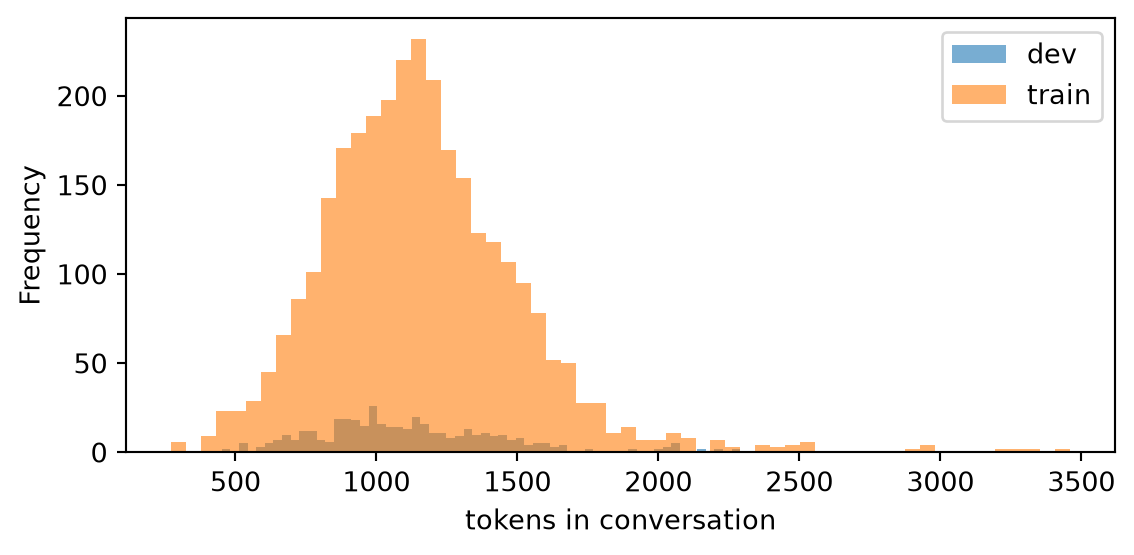
#| fig-cap: "Tokens per full conversation."
lengths.groupby("split").tokens.plot.hist(
    bins=60, alpha=0.6, legend=True, figsize=(6, 3)
)
plt.xlabel("tokens in conversation")
plt.tight_layout()
```
We pick `max_length` as the longest conversation rounded up to a multiple of 256, so that no training
conversation is truncated. Truncating would cut off assistant tokens, which are exactly what the loss
is computed on. The value is saved in the same artifact for later chapters, since stages pass data through files.
```{python}
chosen = get("conversation_lengths").json("lengths.json")
print(
    f"longest conversation: {chosen['longest']} tokens"
    f" -> max_length = {chosen['max_length']}"
)
```
::: {.callout-note title="Under the hood"}
Notice how numbers like `206588` cost one token per digit in this tokenizer. The foundations part looks at
tokenization properly. It is one reason the model writes a program and a Python executor does the
arithmetic.
:::
::: {.callout-tip title="Further reading"}
The ConvFinQA paper [@chen2022convfinqa] describes how the conversations were built and
annotated. The dataset repository is at <https://github.com/czyssrs/ConvFinQA>.
:::